
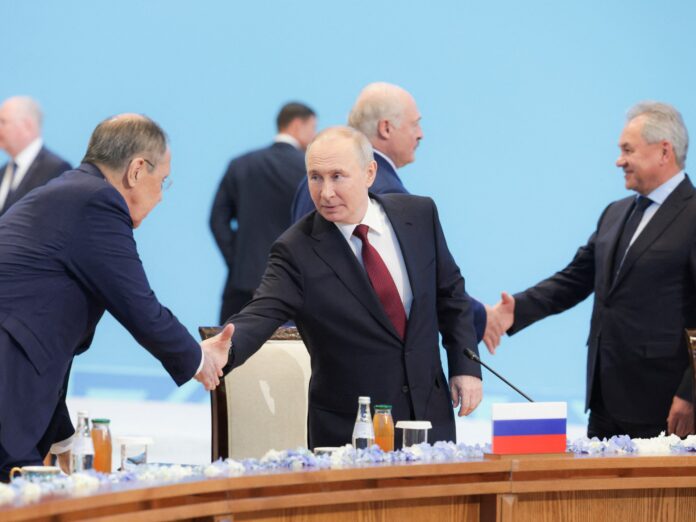

The upcoming Collective Security Council session in Moscow will bring the fraught relationship between Russia and Armenia into sharp focus. President Vladimir Putin is set to chair the meeting, which is part of the Collective Security Treaty Organization (CSTO), a Russia‑dominated military bloc that includes Belarus, Kazakhstan, Kyrgyzstan, Tajikistan and formerly Azerbaijan.
Since February 2024, Armenia’s participation in the CSTO has been effectively frozen. The country has not taken part in any of the bloc’s activities, a de facto boycott that began after the 2020 Nagorno‑Karabakh war. Armenian Prime Minister Nikol Pashinyan declared on November 5 that “our interest in the CSTO has run its course,” underscoring a growing rift between Yerevan and Moscow.
During the 2020 conflict, the CSTO failed to deploy troops or provide meaningful support to Armenia, despite its charter calling for collective defense. Russia, along with the other member states, did not send forces, while Azerbaijan, a former CSTO member that withdrew in 1999, relied on Russian‑procured weaponry and advanced drones from Turkey and Israel to secure a decisive victory.
Russia maintains two military bases in Armenia, hosting thousands of servicemen and border guards, yet the alliance’s lack of action in 2020 has left Yerevan feeling abandoned. “What happens next will depend on the nature of the discussions within the organisation,” Kremlin spokesman Dmitry Peskov said, reflecting uncertainty over Armenia’s future role.
Experts suggest that Moscow’s attention is divided. With the war in Ukraine draining resources and Western sanctions tightening, Russia’s capacity to enforce CSTO commitments is diminished. “Yerevan’s timing for these steps is very useful as Russia is too busy with its war in Ukraine and is to a large extent weakened by sanctions and Ukraine’s military strikes on Russian economic infrastructure,” noted Alisher Ilkhamov, head of the London‑based Central Asia Due Diligence think tank.
Meanwhile, Armenia’s anti‑Kremlin stance has been a thorn in Moscow’s side since Pashinyan’s 2018 rise to power, following mass protests against Russia‑backed leaders. The country is also pursuing European Union membership, further distancing itself from Russian influence.
Some analysts view the potential removal of Armenia’s voting rights in the CSTO as a “demonstrative whipping” rather than a substantive change. Galiya Ibragimova, a Moldova‑based Central Asia expert, explained that other CSTO members, more economically dependent on Russia, are likely to remain silent or observe the situation closely.
The Moscow summit will therefore serve as a litmus test for Russia’s waning grip on former Soviet allies. Whether the CSTO can adapt to the shifting geopolitical landscape or will continue to be perceived as ineffective remains to be seen.
Source: Al Jazeera
Read the original article
Editorial note: This is an original news report prepared from the attributed source material with AI assistance. It is not a reproduction or translation of the original article.

