
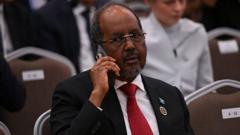

The Supreme Court of Somalia has declared President Hassan Sheikh Mohamud’s extension of his mandate unlawful, a decision that could reshape the country’s electoral calendar and intensify an already tense political standoff.
Mohamud’s four‑year term ended in May, but his administration had pushed through a parliamentary law in March that added an extra year to his presidency. The court ruled that the constitutional amendment could not be applied retroactively to the current term, effectively nullifying the extension.
In a separate ruling, the court found the president’s dismissal of Chief Justice Bashe Yusuf Ahmed “null and void,” stating that the removal violated established constitutional procedures. The chief justice had been removed a day earlier by the president, a move the court said the president had no authority to make.
Following the dismissal, the president appointed Ibrahim Idle Suleiman, a former chief justice, to the position. The court, however, reaffirmed that any removal of the chief justice must follow the proper legal process.
Former Prime Minister Hassan Ali Khaire has accused the president of deploying security forces to the Supreme Court and attempting to arrest the chief justice, describing the action as an “assault on the Supreme Court.” While the AFP could not independently verify the deployment, photographs circulating in Somali media appear to show armed personnel inside the court compound.
In light of the rulings, the Supreme Court has ordered political leaders to agree on an electoral plan within 30 days and to hold elections within 90 days. This directive could disrupt the government’s plan to conduct nationwide polls next year, including parliamentary elections scheduled for 15 April 2027 and a presidential vote a month later.
Former President Sharif Sheikh Ahmed welcomed the court’s decision, noting that the country is facing a “grave political crisis” and urging the current president to adopt a consensus‑based approach to governance.
With Somalia’s last nationwide direct elections held in 1969 and the country still grappling with civil war and the influence of the Islamist group al‑Shabaab, the Supreme Court’s ruling is seen as a critical check on executive power and a step toward restoring the rule of law.
Source: BBC World
Read the original article
Editorial note: This is an original news report prepared from the attributed source material with AI assistance. It is not a reproduction or translation of the original article.

