
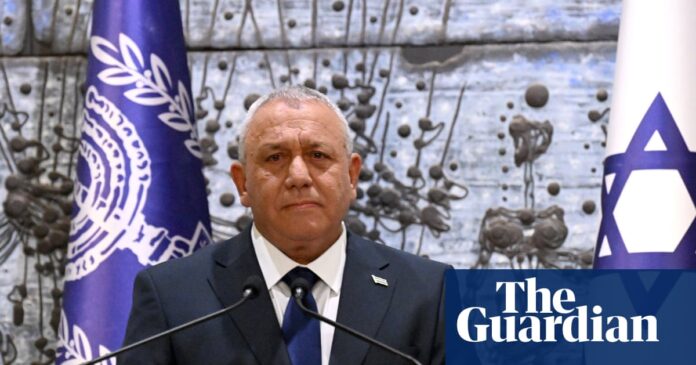

In a historic ceremony at the presidential office, former Israeli Chief of Staff Gadi Eisenkot was formally tasked by President Isaac Herzog with forming a new government. The 66‑year‑old leader of the Yashar party was given 28 days to assemble a coalition, a daunting task given his bloc’s 48 seats in the 120‑member Knesset, short of a majority.
During the ceremony, Eisenkot addressed the nation in a suit and tie, a departure from his usual all‑black attire. He warned that Israel was “in a state of emergency, approaching a point of no return” and called for a national emergency government that would require “creative and unconventional political steps.”
He has outlined three potential paths to a majority: a power‑sharing agreement with Prime Minister Benjamin Netanyahu, support from Arab‑led parties, or an alliance with ultra‑Orthodox parties that demand military exemptions for their communities. Eisenkot noted that several members of his bloc are reluctant to seek Arab support, while the ultra‑Orthodox parties have historically been difficult to negotiate with.
Eisenkot’s appeal to Netanyahu’s Likud party and the far‑right finance minister’s party, Bezalel Smotrich, was clear: they could join his coalition only if he remains the prime minister. He emphasized that his door was open “wholly and willingly” to any party that understood the gravity of the moment.
The former military chief also highlighted Israel’s growing diplomatic isolation. He said that even the United States, Israel’s closest ally, was calling for a reassessment of the relationship amid the devastation in Gaza and the unpopular Iran war that Netanyahu had launched with former President Donald Trump. He added that the international criminal court had issued warrants for Netanyahu, further complicating Israel’s international standing.
Israel’s political landscape remains fragmented. In the October elections, Netanyahu’s camp secured 53 seats, while Eisenkot’s opposition bloc won 48. Neither side holds a majority, making coalition building essential. If Eisenkot succeeds, he would become the first prime minister to replace Netanyahu, who has served as Israel’s longest‑serving premier.
President Herzog’s endorsement of Eisenkot’s mandate was seen as a signal of the urgency of the situation. The former military chief’s challenge will be to navigate the complex web of alliances and opposition while maintaining Israel’s security and democratic values.
Source: The Guardian World
Read the original article
Editorial note: This is an original news report prepared from the attributed source material with AI assistance. It is not a reproduction or translation of the original article.

