
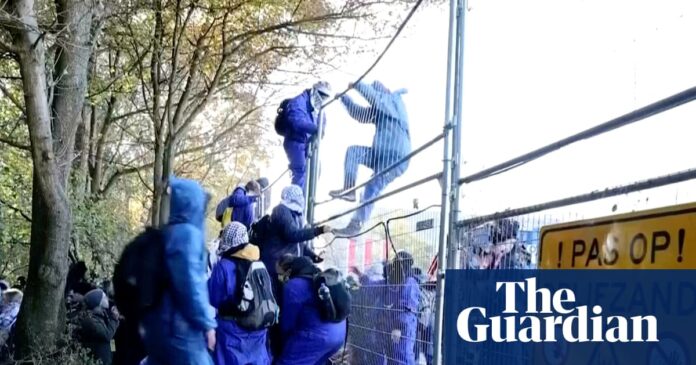

In a dramatic display of dissent, activists from the Dutch direct‑action group Geef Tegengas broke into the construction site of a new Microsoft data centre in Westpoort, Amsterdam. The group scaled a temporary fence, climbed a crane, and set off flares, while also tying helium balloons to equipment. Protesters hung banners accusing Microsoft of supporting the Israeli military and U.S. Immigration and Customs Enforcement (ICE). The action was part of a broader European backlash against the rapid expansion of energy‑hungry AI infrastructure.
Police responded with force, deploying tear gas to disperse the activists. An officer sustained a minor injury during the confrontation. Organisers and local media reported that hundreds of protesters stood on each side of the fence, clashing with law enforcement. The incident was separate from the pan‑European “Stop Dirty Data Centres” campaign, which had coordinated protests at the same site but kept its members outside the perimeter.
Across Europe, the “Stop Dirty Data Centres” coalition—comprising national branches of Greenpeace, Friends of the Earth, and other independent groups—has mobilised more than 100 groups in a two‑day series of protests. The coalition calls for moratoria on new data centre construction, citing concerns over environmental impact, local community disruption, and the lack of transparency in decision‑making.
In addition to Amsterdam, smaller protests erupted in Bristol (UK), Berlin (Germany), Warsaw (Poland), and Zagreb (Croatia). Organisers anticipate further demonstrations on Saturday, as the AI boom continues to attract scrutiny from environmental and social justice advocates.
Owen Espley, campaign coordinator for the coalition, warned that “big tech and government are racing ahead with large‑scale data centre development despite significant public concern about the impacts on local communities, natural resources and other industries.” He added that many projects are planned with limited scrutiny, leaving communities feeling excluded from the decision‑making process.
Source: The Guardian World
Read the original article
Editorial note: This is an original news report prepared from the attributed source material with AI assistance. It is not a reproduction or translation of the original article.

